
Arrest History in Middlesex County
Middlesex County arrest records begin with the agency that acted. Middletown, Cromwell, Portland, East Hampton, Clinton, Old Saybrook, and other towns have municipal police departments. Resident state troopers and Connecticut State Police serve other towns. University police and state or federal specialty agencies may also have jurisdiction. No Middlesex County sheriff exists to collect all these reports into one county arrest portal.
An arrest creates several linked records. Police document the incident, legal basis, alleged offenses, and release or transport. Fingerprints and booking data support identity and reporting to the State Police Bureau of Identification. Prosecutors decide which charges to file, the Superior Court builds a docket, and CT DOC adds a custody record when the person enters its unified system. Differences among those products often reflect later decisions, not an error.
Start With the Middlesex Arresting Agency
The first practical question is not “Which county office?” It is “Which agency made the arrest?” A Middletown Police event stays with Middletown Police for the narrative. A Cromwell event stays with Cromwell Police. In a resident-trooper town or on a state-policed road, the report may belong to the responsible State Police troop. Court staff can supply filed case documents but usually do not hold the officer's full incident narrative.
The official Middletown Police Department page is pictured below.

For an arrest within Middletown city jurisdiction, contact that department with the date, place, involved name, and incident number when known.
The official Middletown city source also provides local department routing.

That local channel matters because a statewide docket or custody entry will not reproduce every fact from a city police report.
How to Look Up Middlesex County Arrests
No single search covers every arrest in Middlesex County. Use this channel-complete sequence, changing the order only when an incident number or known docket makes a later step more direct.
- Identify the town, road, campus, or facility and determine the arresting police agency.
- Check the CT DOC Inmate Search for present state custody, using name and date of birth or an inmate number.
- Search the Judicial Branch pending-case page, then the disposed-case page, for filed charges and court status.
- Call or visit the arresting agency's records counter and request the incident or arrest report.
- Use that agency's form or a Connecticut FOIA request when no direct online record is available.
- For a statewide personal history, follow the DESPP/SPBI criminal-history process rather than relying on a local report.
A State Police report request goes through the DESPP forms or report channel. A municipal event goes to that municipality. Ask for the exact product and include requester contact details, date and location, names, incident number, relationship to the event, and preferred delivery method.
Middlesex Arrests and DOC Custody
Connecticut has no Middlesex County jail. CT DOC has operated a unified state system since 1968 and can hold both sentenced people and accused people awaiting trial. No current DOC prison is listed within Middlesex County, and assignment depends on status, capacity, classification, sex, and operations. Never assume every local arrestee goes to one facility.
The DOC search accepts a CT DOC inmate number or a last name, with first name and date of birth used to narrow a match. Public fields can include name, inmate number, birth date, accused or sentenced status, controlling offense, current location, admission and sentencing dates, and release-related dates. Youthful-offender cases and ICE-only holds are excluded.
The official DOC inmate information page displays the update and fallback guidance.
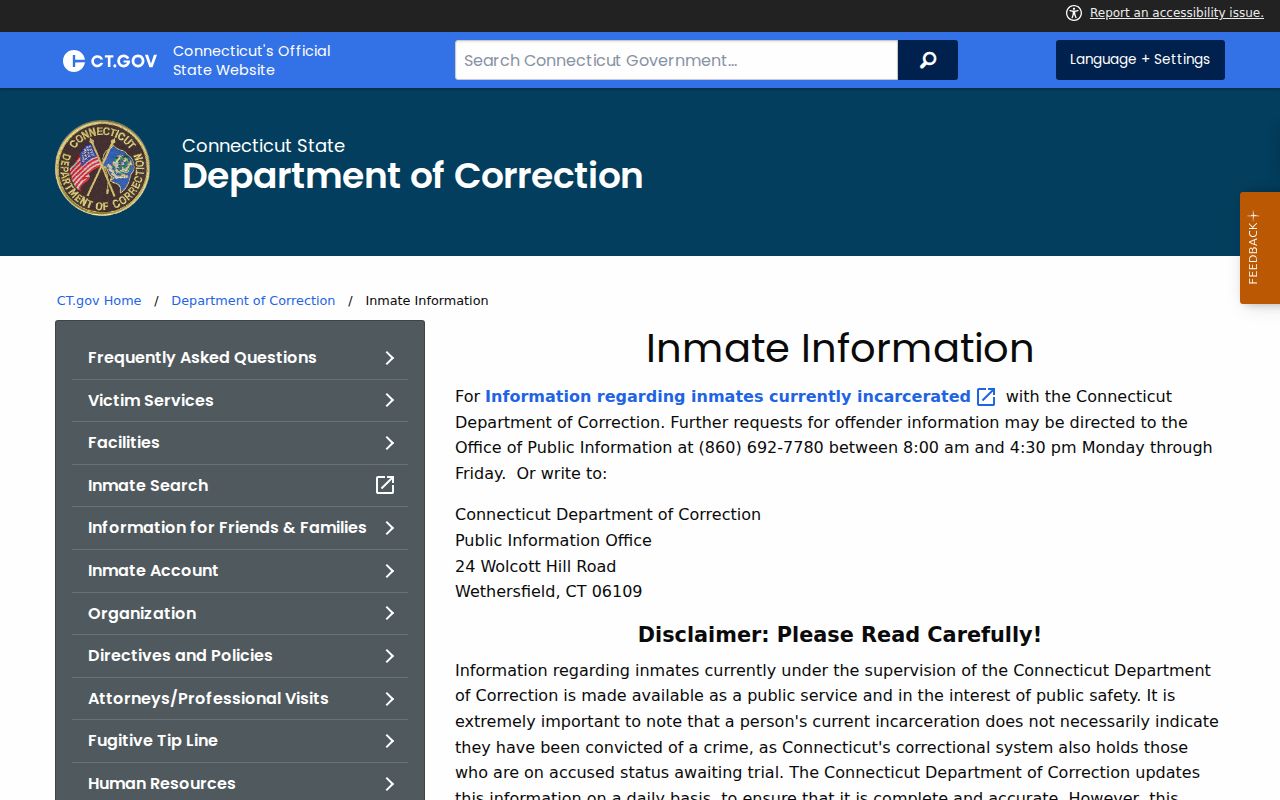
DOC updates daily, so a fast-changing release or transfer may require a call to Public Information at 860-692-7780 during its listed weekday hours.
What an Arrest Record Shows
An arrest report and booking entry overlap, but they are not the same. Police reports focus on the event and legal basis. DOC custody profiles focus on identity, location, and status. Public access can be reduced by juvenile, youthful-offender, victim, witness, medical, active-investigation, and personal-identifier rules.
| Incident or Arrest Number | The police agency's identifier, which is different from a Superior Court docket number. |
|---|---|
| Date, Time, and Place | When and where the arrest or reported event occurred. |
| Arresting Agency | The municipal department, State Police unit, or other authorized agency that created the report. |
| Alleged Charges | Probable-cause allegations at arrest, which prosecutors may revise. |
| Authority and Narrative | Warrant or warrantless basis and the officer's account, subject to redaction. |
| Booking Identity | Fingerprints, photograph, identifiers, and inmate number when created. |
| Custody or Release | Transport, bond, recognizance, DOC transfer, or other disposition at that stage. |
A booking photograph is one field in an agency file, not the purpose of a public arrest search. Release depends on the responsible agency and applicable access limits. No photographs or accused-person names are republished here.
Cromwell Roads and Arrest Jurisdiction
Cromwell lies along I-91 and Route 9 just north of Middletown. Depending on the exact site and event, Cromwell Police or Connecticut State Police may hold the originating record. Confirm jurisdiction before sending a request. A town-road assumption can send the requester to the wrong custodian.
The Cromwell Police Department records source is shown below.
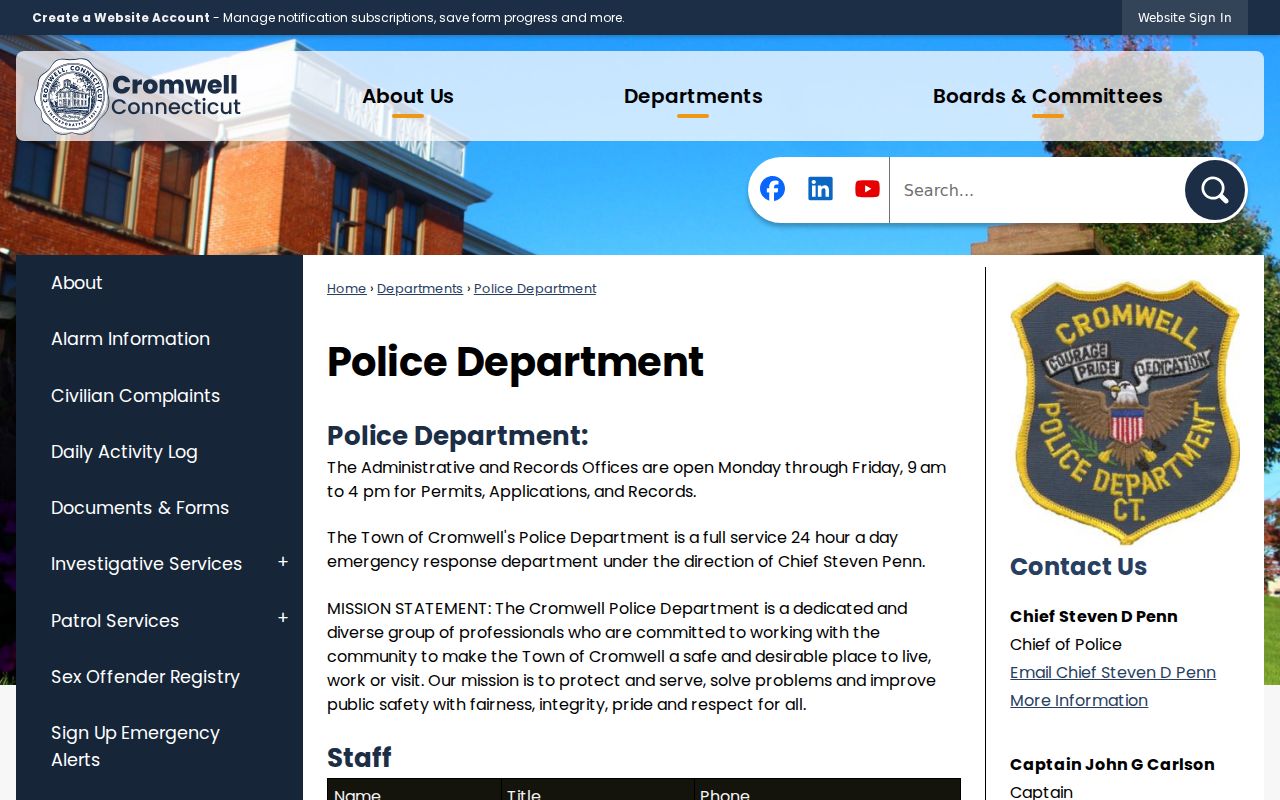
Use the department's current page for its records contact and forms rather than guessing a county process.
The official Cromwell town page provides the town-level route pictured here.
Once a Cromwell arrest reaches prosecution, the case record moves to Superior Court in Middletown even though the police narrative remains with the town.
Recent Arrests and Booking Logs
No comprehensive Middlesex County booking log was located in the official research. That result fits Connecticut's structure: there is no county sheriff or jail to publish a central roster. Police news releases and blotters can be selective. They should not be mistaken for a full list of arrests, and an absent name proves nothing.
For a recent event, combine agency contact, the statewide DOC locator, and the Judicial Branch pending docket. DOC may show custody after transfer, while the court lookup can show filed charges after data entry. The arresting department remains the source for the narrative. If a person has already been released and no public case has posted, a direct records request may be the only useful public route.
Resident Trooper Arrests in Middlesex
Middlesex County's police map is fragmented. Larger and shoreline towns often maintain departments, while some inland municipalities rely on resident troopers or State Police. A resident trooper works within the state system, so the relevant troop or DESPP report process may control access even when the event occurred inside a town.
Describe the location with care. Give the road, town, date, time, names, and incident number if known. DESPP's report form can require requester information, the requester’s relationship to the event, identification, and later payment after the record is found. Court filings still go to the Superior Court clerk, not to police FOIA staff.
Connecticut FOIA applies to nonexempt agency material, but court records follow Judicial Branch rules. This distinction prevents a common Middlesex error: sending one broad request to the courthouse for both a police narrative and the criminal docket.
Middlesex Arrest Charge Versus Filed Charge
Arrest charges reflect the officer's probable-cause decision at the time of custody. The State's Attorney reviews that work and may add, remove, or change counts through the filed information. The court then records a plea and disposition for each count. Three official records can therefore list different charge sets.
| Product | Custodian | Best use |
|---|---|---|
| Police arrest report | Arresting agency | Event, probable cause, officer action, and initial charges |
| Superior Court docket | Judicial Branch clerk | Filed counts, events, pleas, outcomes, and sentence |
| SPBI criminal history | DESPP State Police Bureau of Identification | Identity-linked Connecticut arrest cycles and reported dispositions |
| DOC custody profile | CT DOC | Current location and accused or sentenced custody fields |
If an official personal history lacks a disposition, obtain the court outcome and follow the challenge instructions supplied with the SPBI record. Ask the reporting court or originating agency to verify a proven mismatch.
Youthful Arrest Records Stay Restricted
Juvenile and youthful-offender arrest matters do not appear through ordinary public searches. Connecticut statutes and Judicial Branch rules protect those proceedings. FOIA does not unlock them, and a missing result should not prompt a search through unofficial people-finder or mugshot sites.
Erasure creates another lawful gap. Qualifying nonconviction outcomes and eligible Clean Slate cases can be removed from ordinary public effect under §54-142a. An agency may also redact protected victim, witness, medical, and personal information or withhold active investigative material when the law permits.
For self-review, an official SPBI history and the court disposition provide a sound correction path. A name-only public result is never enough to establish identity.
Arrests vs Convictions
An arrest records an accusation and custody event. A conviction records guilt by plea or verdict. They arise at different stages, are maintained by different offices, and can have different public-access outcomes.
| Arrest Record | Conviction Record |
|---|---|
| Created by the police agency and, for custody, DOC | Created by Connecticut Superior Court |
| Shows that an arrest or booking occurred | Shows a guilty plea or verdict on a count |
| May list initial probable-cause charges | Lists the court's filed charge and disposition |
| Can lead to release, no filing, dismissal, or acquittal | Can lead to sentence, appeal, pardon, or eligible erasure |
Note: An arrest is not proof of guilt, and CT DOC may label a person “Accused” before any conviction occurs.
Use the Middlesex County criminal court case record when the goal is to confirm what prosecutors filed and how the court resolved each count.