
How to Check Criminal History in Middlesex County
No single search produces a complete Middlesex County criminal history. The Connecticut Judicial Branch Criminal/Motor Vehicle Case Look-up shows public pending and disposed cases. DESPP's State Police Bureau of Identification, or SPBI, supplies the official state criminal-history product. Connecticut DOC reports custody data, and the Connecticut Sex Offender Registry covers only registration information.
Begin with a full name, prior names, likely spellings, birth year, town, and any docket or incident number. A common name alone is not enough to identify a person. Search pending and disposed court pages separately because each covers a different case status.
- Search the Judicial Branch pending-case page, then repeat the name on the disposed-case page.
- Use birth year and the Middlesex JD or Middletown GA 9 court filters to narrow likely matches.
- Open the docket, compare identifiers, and record the exact docket number and each count's status.
- Ask the arresting police agency for its report, or check DOC only when custody information matters.
- Contact the clerk for a certified disposition or obtain an SPBI report when an official statewide history is needed.
Four Middlesex County Record Systems
Middlesex County records move through four public systems that answer different questions. A court docket reports the filed case and outcome. SPBI assembles repository history. DOC reports incarceration or release fields. The registry publishes information required by Chapter 969. An arresting agency's narrative can contain facts absent from all four.
Official Connecticut Background Checks
SPBI is the authoritative Connecticut channel for reviewing an official state history. A name and date-of-birth search can locate a repository match, while a fingerprint-supported request gives stronger identity assurance. The public can request Connecticut conviction information; a subject can request a fingerprint-supported copy of their own record.
The official CCHRS pre-enrollment system uses a service code to select the product, collect identity and contact details, accept payment, and issue a barcode. The requester then follows the specified LiveScan or fingerprint-card route.
The CCHRS source shows how pre-enrollment begins before fingerprint capture.
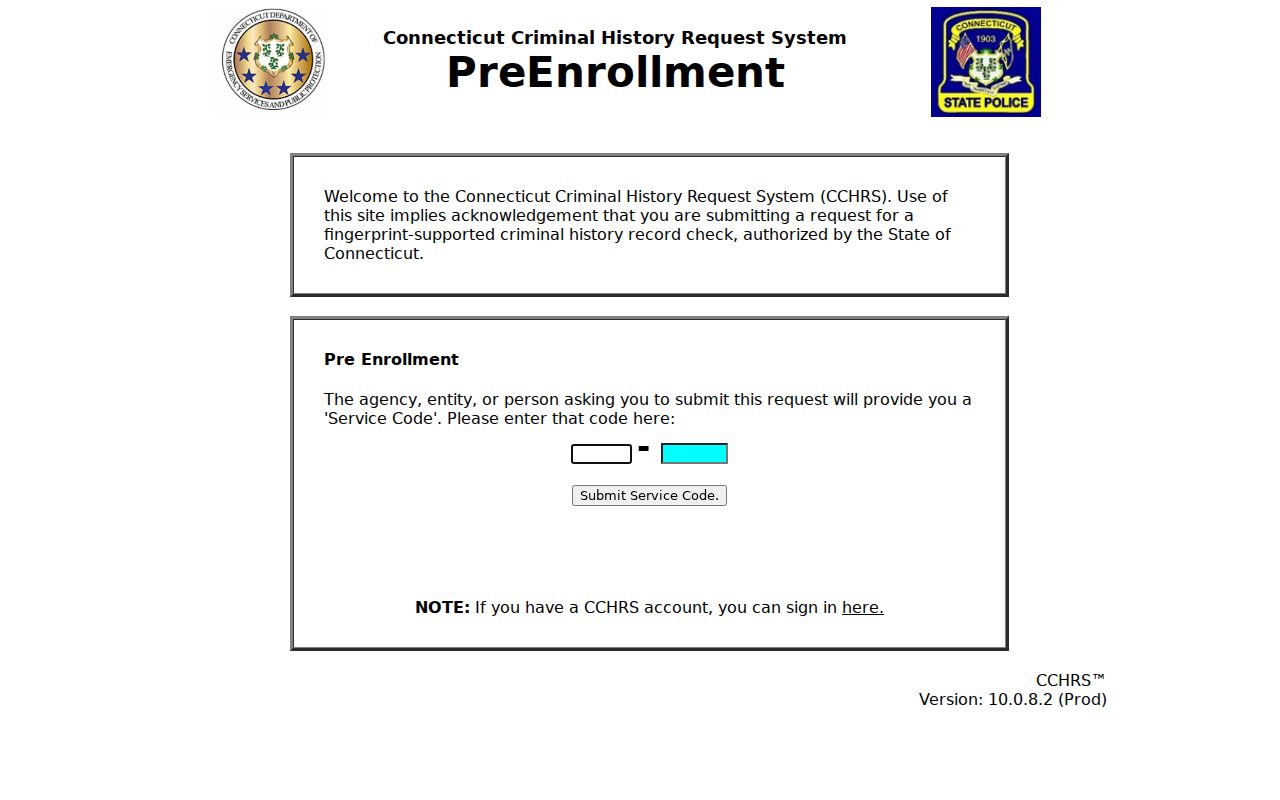
The barcode and service code must match the intended request, so the transaction instructions control.
Middlesex County Fingerprint Checks
Middlesex County has an unusual local advantage: Connecticut State Police Headquarters and SPBI are at 1111 Country Club Road in Middletown. Fingerprinting there is by appointment. Bring the appointment confirmation, CCHRS barcode, acceptable photo identification, and the payment forms required for the selected service.
| Product or service | Published charge |
|---|---|
| Connecticut name/DOB history search | $75 |
| Fingerprint-supported Connecticut history | $75 plus capture fee |
| Authorized Connecticut and FBI check | $88.25 plus capture fee |
| State Police fingerprint card capture | $15 per card |
The SPBI records page publishes the available request channels and fees.
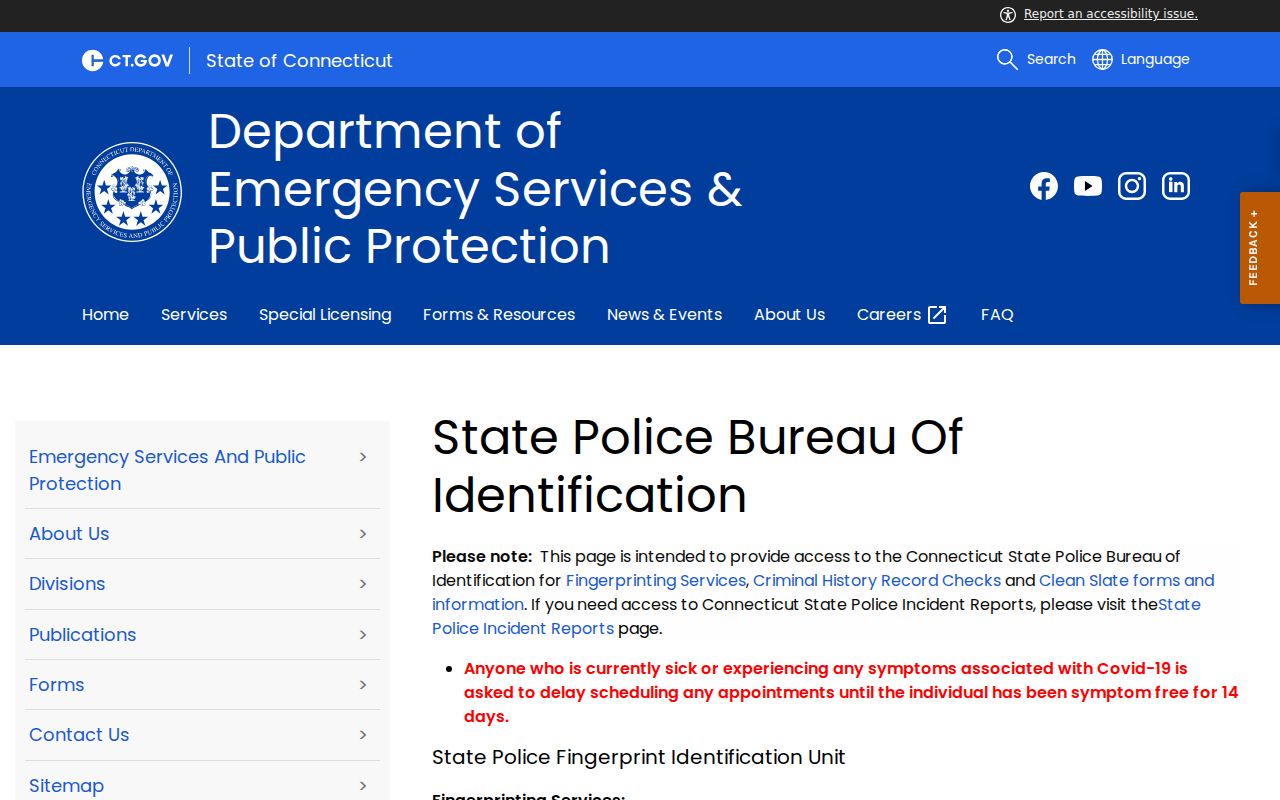
Local police departments may set a different fingerprint-capture fee, and the service-code checkout should be checked for the current total.
Types of Criminal Records
Middlesex County criminal records are defined as much by their creator as by their subject. A municipal department or State Police troop creates incident and arrest reports. Superior Court creates the docket and judicial file. SPBI receives identity-linked arrest and disposition data, while DOC creates custody records.
- Incident and arrest reports describe the police response, alleged conduct, legal basis, and agency action.
- Court files show filed counts, appearances, pleas, motions, outcomes, sentences, and public financial entries.
- Repository histories organize identity-linked arrest cycles and reported dispositions held by SPBI.
- Custody and warrant records answer limited questions about detention or court-issued process.
- Supervision and registry records come from state probation, parole, DOC, and DESPP systems with distinct access limits.
Middlesex County Records Without a Sheriff
Connecticut abolished county sheriffs, and Middlesex County has no operating county government or sheriff records unit. Judicial Marshals secure courthouses and transport prisoners, but they do not maintain a county arrest database. Start an incident or arrest request with the municipal department, resident trooper, or State Police troop that created the report.
A useful request states the incident number if known, date and location, names of involved people, requester relationship, desired report or media, and delivery format. Police may redact active-investigation material, protected victim or witness details, juvenile information, medical data, and personal identifiers. Court filings go to the Superior Court clerk rather than an executive-agency FOIA office.
Middlesex Judicial District
1 Court Street, Middletown, CT 06457-3374
Clerk/public information: 860-343-6400
DESPP/SPBI
1111 Country Club Road, Middletown, CT 06457
Criminal Records Unit: 860-685-8480
Middletown Police
222 Main Street, Middletown, CT 06457
Main line: 860-638-4000
What a Middlesex County Criminal Record Shows
Contents vary by source. A Connecticut repository history may combine an identification segment with fingerprint-linked arrest cycles, agencies, alleged charges, dispositions, sentences, and custody references. Public court pages omit sensitive identifiers and confidential matters, while a police narrative can include incident facts not found in a docket.
| Name & Identifiers | Legal and prior names, birth data, state identification or fingerprint transaction numbers, depending on the product. |
|---|---|
| Arrest / Booking Data | Arrest date, agency, alleged offenses, incident or arrest number, and booking fields where available. |
| Charges & Statutes | Each alleged or filed offense, Connecticut statute, class, and count-level information. |
| Disposition | Plea, nolle, dismissal, acquittal, conviction, or another recorded outcome for each count. |
| Sentence | Incarceration, suspended time, probation, fines, restitution, and concurrent or consecutive structure. |
| Custody / Supervision Status | DOC admission, location, accused or sentenced status, release fields, or public supervision references. |
Reading Middlesex County Dockets
The disposed-case form requires a last name and can narrow by first initial, birth year, year range, court, and category. Search both Middlesex JD and Middletown GA 9 because serious Part A matters and Part B matters share the courthouse but appear under distinct location values. Pending and disposed searches are separate.
An arrest number is not a court docket. A prosecutor may replace arrest charges with a different information, and separate counts may have different results. The full Middlesex County criminal court case guide explains the court record in more depth.
Public Access Laws
Connecticut FOIA opens nonexempt executive-agency records, but it does not override erasure, youthful-offender confidentiality, protected victim information, or another specific restriction. Judicial records follow Judicial Branch rules and clerk procedures. A public name result also requires identity checking because the law does not make every same-name match accurate.
Key Statutes:
Conn. Gen. Stat. §§ 1-200 through 1-242 - FOIA covers nonexempt agency records but yields to confidentiality laws.
Conn. Gen. Stat. § 54-142a - qualifying nonconviction and Clean Slate records are erased under stated conditions.
Conn. Gen. Stat. § 54-142k - controls dissemination and use of criminal-history information held by criminal-justice agencies.
Conn. Gen. Stat. §§ 54-250 through 54-261 - govern registration, public registry data, duties, and misuse.
Conn. Gen. Stat. §§ 54-76b et seq. - keep youthful-offender proceedings and records confidential.
Middlesex County Custody Without a County Jail
Connecticut DOC, not Middlesex County, maintains custody information for sentenced prisoners and many accused people held before trial. Search by CT DOC inmate number for the strongest match, or combine last name, first name, and date of birth. The public profile can show current location, admission date, controlling offense, accused or sentenced status, and sentence or release fields.
The official DOC inmate search is the statewide custody channel for a Middlesex County arrest that led to detention.
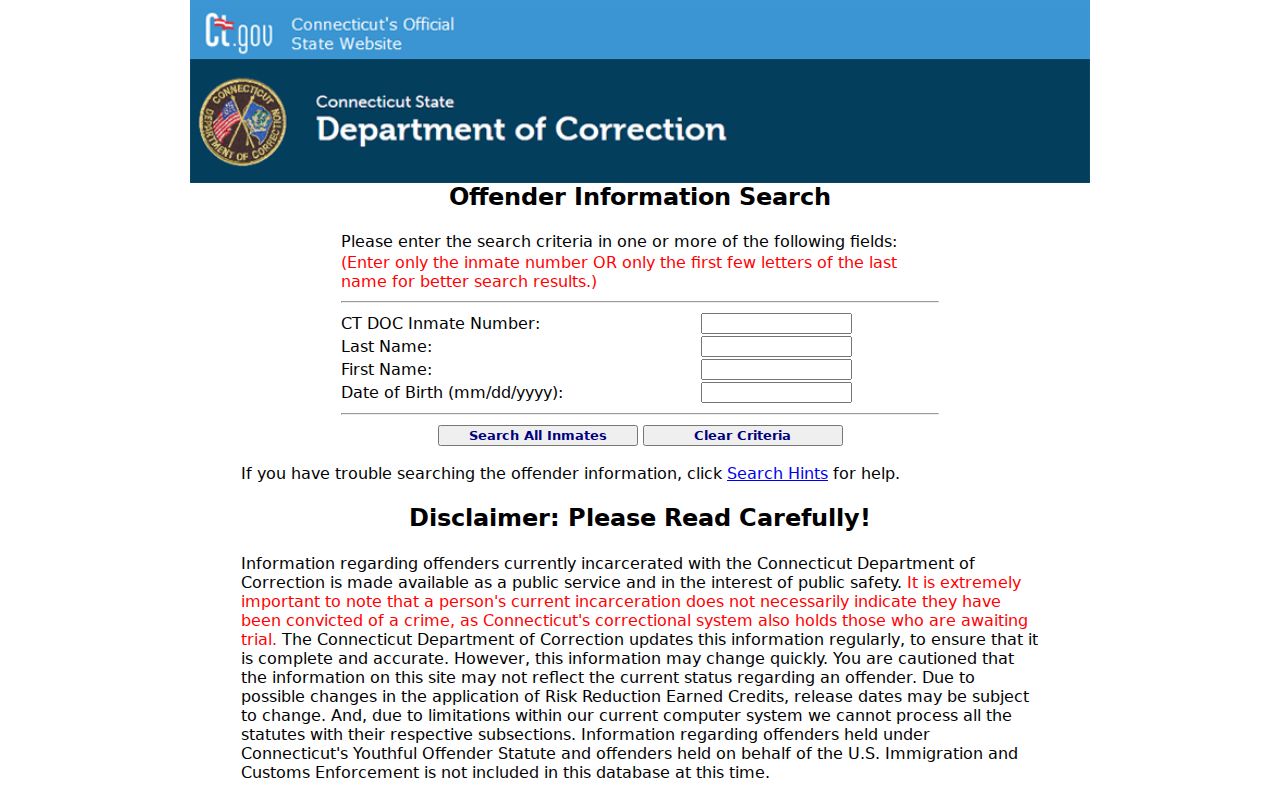
DOC updates daily, excludes youthful offenders and ICE-only holds, and warns that accused status does not establish a conviction. Use the court docket to confirm the case outcome.
Sealed, Expunged & Restricted
Connecticut's primary adult remedy is erasure. Section 54-142a covers qualifying dismissals, acquittals, mature nolles, and eligible Clean Slate convictions. Public case look-up excludes erased, sealed, juvenile, youthful-offender, and other confidential matters. Absence from the search can therefore mean restriction, not proof that no event occurred.
Eligible post-2000 convictions may follow an automatic or hearing route; qualifying older convictions use the court petition process. An absolute pardon is a broader Board of Pardons and Paroles remedy that produces erasure. Each route has offense, waiting-period, sentence-completion, and pending-case rules.
The state's Clean Slate page distinguishes automatic erasure from petition routes.
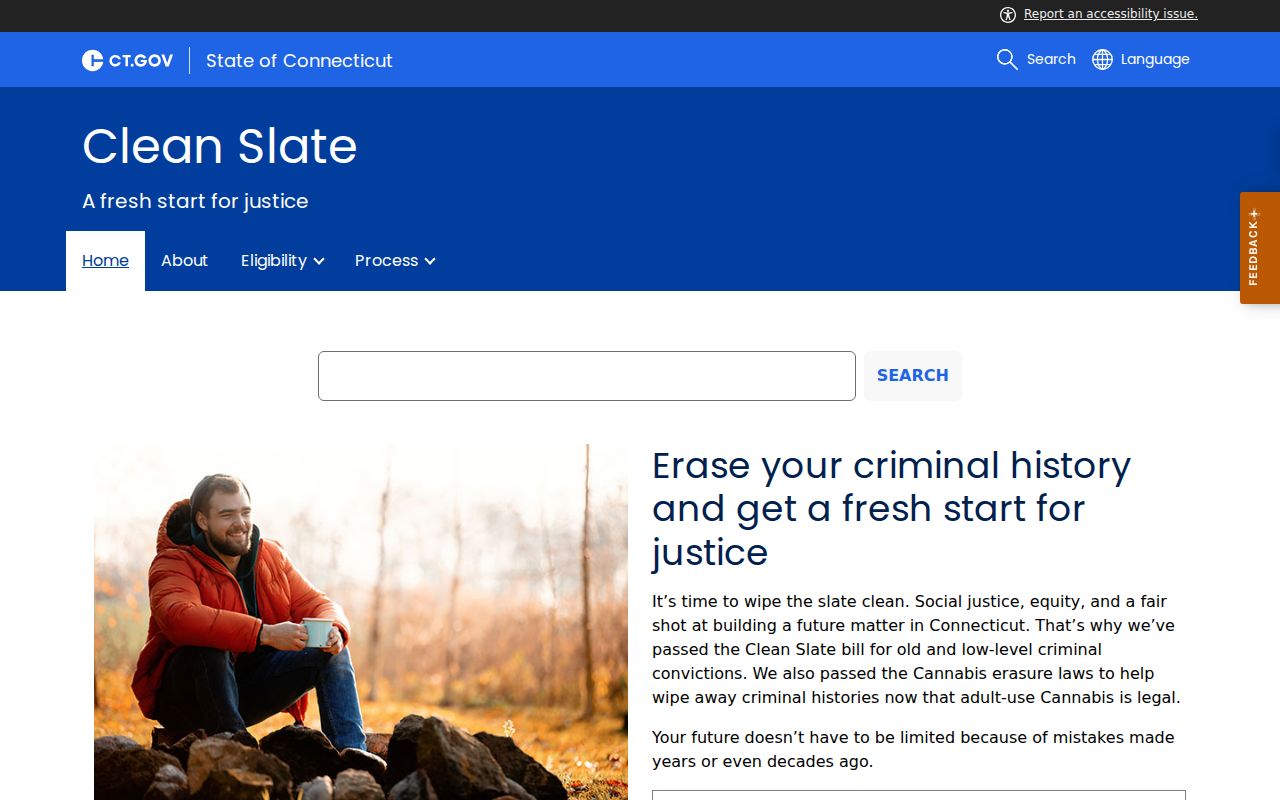
A petitioner should compare an official SPBI history with the court overview and obtain missing police records before filing.
Middlesex County Clean Slate Records
Automatic Clean Slate generally addresses eligible misdemeanors after seven years and qualifying Class D, Class E, or certain unclassified felonies after ten years, with all incarceration and supervision complete. Excluded offenses do not become eligible merely because a statute number appears on a general list. Pre-2000 qualifying matters use Judicial Branch form JD-CR-202.
The Board charges no absolute-pardon application fee, but applicants ordinarily need a recent fingerprint-based SPBI history and supporting records. An absolute pardon considers the whole criminal history rather than erasing one selected count.
The official pardon FAQ explains how an absolute pardon leads to Connecticut erasure.
The Board may interview an applicant, and its current instructions control document and waiting-period requirements.
The Board of Pardons and Paroles is the official source for current application routes and board information.
Probation records remain with Judicial Branch Adult Probation, while parole decisions and field supervision are split between the Board and CT DOC.
Middlesex County Warrants and Police Reports
No comprehensive public Middlesex County warrant list was found. A public pending docket may show a failure-to-appear or capias event, but sealed or unserved warrants may not appear. A person addressing their own suspected warrant should obtain the docket number, speak with counsel or the clerk, and confirm safe instructions with the responsible police agency.
Police and incident reports remain with the department or State Police troop that wrote them. Adult probation is a Connecticut Judicial Branch function; the Middlesex supervision office is at 484 Main Street in Middletown. The Board decides parole, and CT DOC's Division of Parole and Community Services supervises release. None is a general public database of officer notes, treatment details, or risk information.
- Nolle prosequi
- A prosecutor's decision not to continue a charge, not a guilty finding.
- Disposition
- The recorded outcome of an individual court count.
- Capias
- A court order commanding arrest or appearance.
- Accused status
- A DOC custody label that does not show a final conviction.
Federal Criminal Records for Middlesex County
Federal cases are separate from Connecticut records. Middlesex County lies in the U.S. District Court for the District of Connecticut, and PACER provides federal dockets and filed documents under the judiciary's account and fee rules. The FBI Identity History Summary is a subject-only fingerprint product, while the Federal Bureau of Prisons locator covers federal rather than Connecticut custody.
A state court search will not replace PACER, and an SPBI history is not the same product as an FBI summary. Federal warrants can remain sealed. Use the federal clerk, FBI, or BOP channel suited to the record instead of assuming a missing state result means there is no federal matter.
Middlesex County Felonies and Misdemeanors
Connecticut classifies most felonies and misdemeanors by letter, but the offense statute and sentence entry must be read together. Felonies generally use Classes A through E plus unclassified offenses. Misdemeanors generally use Classes A through D plus unclassified offenses. Every adult criminal class is heard in Connecticut Superior Court, not a county or municipal criminal court.
| Class | General imprisonment framework |
|---|---|
| Class B felony | Generally 1 to 20 years, subject to offense-specific rules |
| Class C felony | Generally 1 to 10 years |
| Class D felony | Generally up to 5 years |
| Class E felony | Generally up to 3 years |
| Class A misdemeanor | Generally up to one year, with the nominal maximum generally treated as 364 days |
| Class B, C, or D misdemeanor | Lower maximum terms set by the sentencing statutes |
A docket's class label is not the sentence. Mandatory minimums, enhancements, suspended portions, probation, and concurrent or consecutive terms can change the result. Read each count's disposition and sentence, then confirm any offense-specific rule in the cited statute.
Criminal Records by City in Middlesex County
Municipal police departments keep their own incident and arrest reports, but Connecticut towns do not operate municipal criminal courts. Middletown, Cromwell, and Clinton cases route to Superior Court in Middletown, while custody and repository records remain statewide. The city guides focus on the local department and the correct path from police report to state court.
Middletown Criminal History
47,717 · Police reports begin at 222 Main Street; criminal cases go to 1 Court Street.
Cromwell Criminal History
14,225 · Confirm whether Cromwell Police or State Police created the record.
Clinton Criminal History
13,185 · Clinton Police uses its CPD-148 request form; cases route to GA 9.